Hornet 40: Network Dataset of Geographically Placed Honeypots

Hornet 40: Network Dataset of Geographically Placed Honeypots

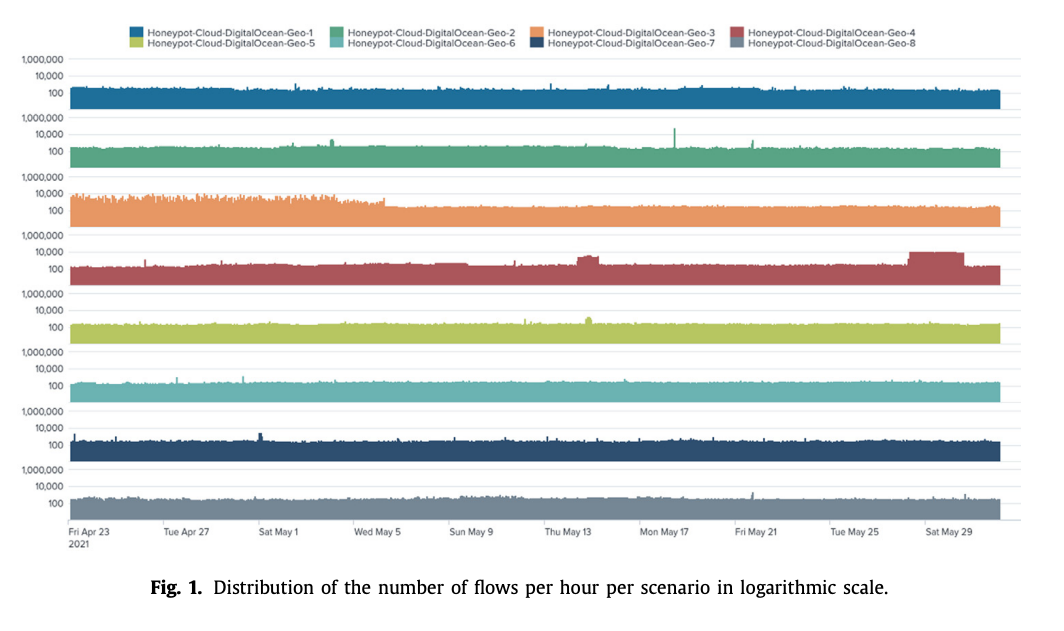
Deception technologies, and honeypots in particular, have been used for decades to understand how cyber attacks and attackers work. A myriad of factors impact the effectiveness of a honeypot. However, very few is known about the impact of the geographical location of honeypots on the amount and type of attacks. Hornet 40 is the first dataset designed to help understand how the geolocation of honeypots may impact the inflow of network attacks. The data consists of network flows in binary and text format, with up to 118 features, including 480 bytes of the content of each flow. They were created using the Argus flow collector. The passive honeypots are IP addresses connected to the Internet and do not have any honeypot software running, so attacks are not interactive. The data was collected from identically configured honeypot servers in eight locations: Amsterdam, Bangalore, Frankfurt, London, New York, San Francisco, Singapore, and Toronto. The dataset contains over 4.7 million network flows collected during forty days throughout April, May, and June 2021.

Entanglement: Cybercrime Connections of a Public Forum Population

Entanglement: Cybercrime Connections of a Public Forum Population

Many activities related to cybercrime operations do not require much secrecy, such as developing websites or translating texts. This research provides indications that many users of a popular public internet marketing forum have connections to cybercrime. It does so by investigating the involvement in cybercrime of a population of users interested in internet marketing, both at a micro and macro scale. The research starts with a case study of three users confirmed to be involved in cybercrime and their use of the public forum. It provides a first glimpse that some business with cybercrime connections is being conducted in the clear.

Cybercrime Specialization: An Exposé of a Malicious Android Obfuscation-as-a-Service

Cybercrime Specialization: An Exposé of a Malicious Android Obfuscation-as-a-Service

Malware authors constantly obfuscate their files and defenders regularly develop new techniques to detect them. Given this cat-and-mouse game, specialized obfuscation services have appeared in the cybercrime industry. These services allow malware authors to obfuscate their code for a fee. This study investigates an automated obfuscation-as-a-service platform for Android applications and yields unique insights on the technical difficulties and business reality of those behind such a specialized service. The service investigated was found to be average in quality, mainly using known obfuscation techniques, and generating obfuscated applications that were still detected by anti-viruses. It had a small clientele of large-scale attackers who used the service to decrease anti-virus detections of highly malicious applications, thus increasing their chances of compromising devices. Depending on the price bundles considered, operators offering the service were estimated to have made a minimum revenue ranging from USD 5,100 (conservative) to USD 61,160 (optimistic) for a six-month operation. This study illustrates that even though obfuscation-as-a-service is a market niche, taking advantage of the value added from this specialization is not effortless nor easily accessible to everyone involved in cybercrime.

ENISA Threat Landscape for Supply Chain Attacks

ENISA Threat Landscape for Supply Chain Attacks

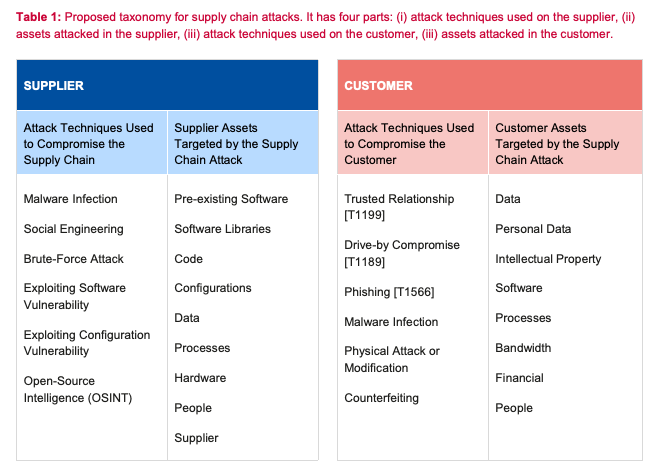
This report aims at mapping and studying the supply chain attacks that were discovered from January 2020 to early July 2021. Based on the trends and patterns observed, supply chain attacks increased in number and sophistication in the year 2020 and this trend is continuing in 2021, posing an increasing risk for organizations. It is estimated that there will be four times more supply chain attacks in 2021 than in 2020. With half of the attacks being attributed to Advanced Persistence Threat (APT) actors, their complexity and resources greatly exceed the more common non-targeted attacks, and, therefore, there is an increasing need for new protective methods that incorporate suppliers in order to guarantee that organizations remain secure.

Uncovering Automatic Obfuscation-as-a-Service for Malicious Android Applications

Uncovering Automatic Obfuscation-as-a-Service for Malicious Android Applications

This research provides the first overview of such automatic service, which takes advantage of the whole malware-as-aservice industry, providing medium quality obfuscation for the Android malware market. Although the technical obfuscations are not state-of-the-art, the service succeeds in reducing detection for malicious Android applications. We conclude that the active use of the service highlights the need for the malware market to develop better obfuscation techniques, hence the good job that the security community is doing at quickly detecting changing malware. We also conclude that this service seemed to generate enough revenue for the group, given its automatic nature and purpose. Given that automatic services like this may be a greater problem in the future of malware obfuscation, this research provides a first technical analysis of the details of such obfuscation service and the possible impact in detection results.

Growth and Commoditization of Remote Access Trojans

Growth and Commoditization of Remote Access Trojans

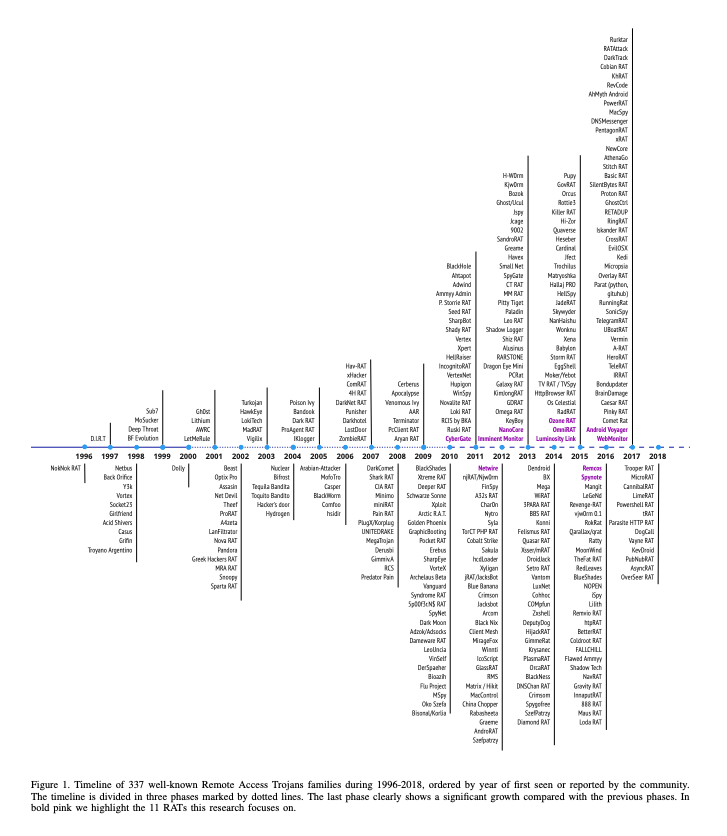
In the last three decades there have been significant changes in the cybercrime world in terms of organization, type of attacks, and tools. Remote Access Trojans (RAT) are an intrinsic part of traditional cybercriminal activities but they have become a standard tool in advanced espionage and scams attacks. The overly specialized research in our community on Remote Access Trojans has resulted in a seemingly lack of general perspective and understanding on how RATs have evolved as a phenomenon. This work presents a new generalist perspective on Remote Access Trojans, an analysis of their growth in the last 30 years, and a discussion on how they have become a commodity in the last decade. We found that the amount of RATs increased drastically in the last ten years and that nowadays they have become standardized commodity products that are no very different from each other.

Disrupting Active Directory Attacks with Deep Learning for Organic Honeyuser Placement

Disrupting Active Directory Attacks with Deep Learning for Organic Honeyuser Placement

Honeypots have been a long-established form of passive defense in a wide variety of systems. They are often used for the reliability and low false positive rate. However, the deployment of honeypots in the Active Directory (AD) systems is still limited. Intrusion detection in AD systems is a difficult task due to the complexity of the system and its design, where any authenticated account is able to query other entities in the system. Therefore, the positioning of the honeypot in such structures brings two main con trains: (i) the placement has to be organic, with similar properties to other, real entities in the structure, and (ii) the placement must not give away the nature of the honeypot to the attacker.

A Better Infected Hosts Detection Combining Ensemble Learning and Threat Intelligence

A Better Infected Hosts Detection Combining Ensemble Learning and Threat Intelligence

Ensemble learning techniques have been successfully proposed and used to improve threats detection in cybersecurity. These techniques usually improve the detection results by combining algorithms that together have less errors. However there has not been any ensemble learning algorithm used to classify network flows when several methods are used to give individual detections for each of the flows.

Geost botnet. The story of the discovery of a new Android banking trojan from an OpSec error

Geost botnet. The story of the discovery of a new Android banking trojan from an OpSec error

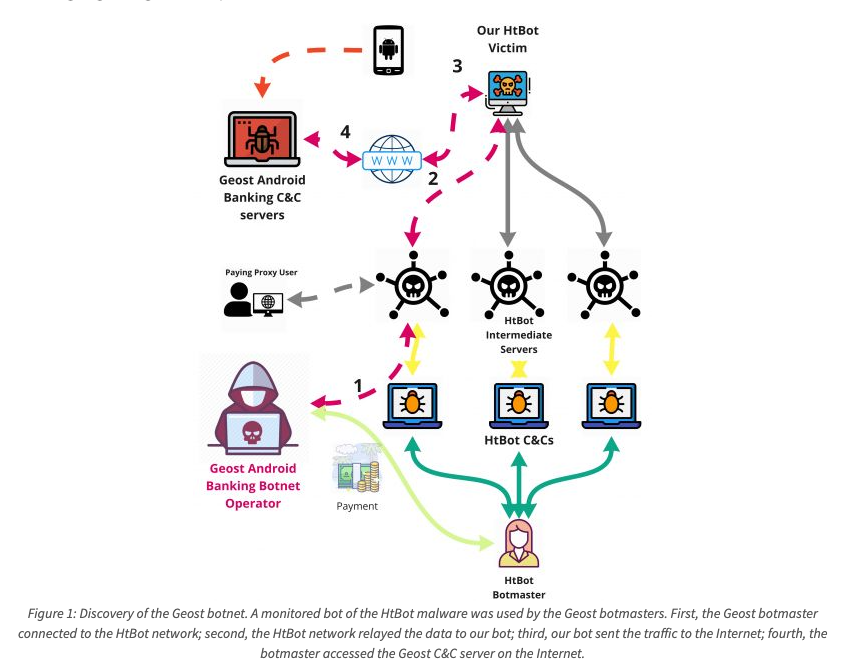
This paper describes an ew botnet, which we called Geost, discovered thanks to multiple OpSec mistakes made by the attackers. The mistakes included: the use of the HtBot malware’s illegal proxy network; failing to encrypt the command-and-control servers; re-using security services; trusting other attackers that practise even less operational security; and failing to encrypt chat sessions. As far as we know, the Geost botnet has hundreds of malicious domains, 13 C&C servers, approximately 800,000 victims in Russia, and potential access to several million Euros in bank accounts.

A Study of Machete Cyber Espionage Operations in Latin America

A Study of Machete Cyber Espionage Operations in Latin America

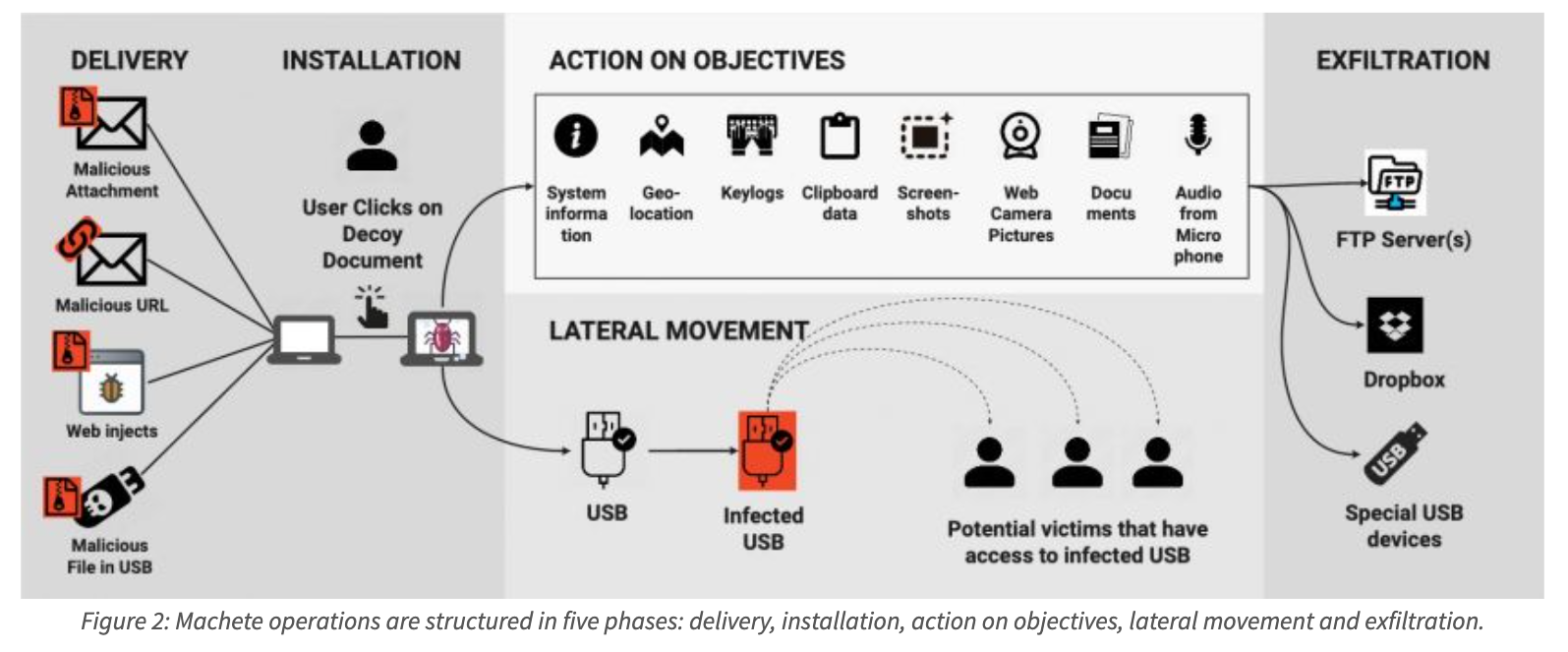
Our research shows that Machete is operated by a highly coordinated and organized group that focuses on Latin American targets. We describe the five phases of the APT operations from delivery to exfiltration of information and we show why Machete is considered a cyber espionage tool. Furthermore, our analysis indicates that the targeted victims belong to military, political or diplomatic sectors. The review of the almost eight years of Machete operations shows that it is probably operated by a single group whose activities may be state-sponsored. Machete is still active and operational to this day.

Analysis of Botnet Behavior as a Distributed System

Analysis of Botnet Behavior as a Distributed System

El crecimiento vertiginoso de nuevas tecnologıas, trae aparejado el crecimiento de aplicaciones maliciosas. Estas aplicaciones hacen uso de los recursos de los dispositivos infectados para realizar actividades ilıcitas, enviar mails de forma masiva (spam) o minar para obtener criptomonedas. Para minar, se requiere grandes capacidades de cómputo Las botnets pueden ser consideradas como un tipo de de aplicación de computación distribuıda. La palabra botnet significa red de robots. Es un tipo de malware, instalado en una computadora que ha sido infectada, con la habilidad de auto propagarse hacia otras máquinas. Todas las computadoras infectadas conforman la “red de bots”, o botnet. Este tipo de malware utiliza los recursos de la computadora infectad (CPU, RAM, ancho de banda), para comunicarse con su Botnet Master, que es quien le da órdenes. El presente trabajo es un estado del arte, se analiza el comportamiento de las botnets como aplicaciones de computación distribuıda. Se considera el comportamiento a nivel de consumo de recursos de los dispositivos que son infectados por el malware, en particular los miners.

Detecting the behavioral relationships of malware connections

Detecting the behavioral relationships of malware connections

A normal computer infected with malware is difficult to detect. There have been several approaches in the last years which analyze the behavior of malware and obtain good results. The malware traffic may be detected, but it is very common to miss-detect normal traffic as malicious and generate false positives. This is specially the case when the methods are tested in real and large networks. The detection errors are generated due to the malware changing and rapidly adapting its domains and patterns to mimic normal connections.

Modelling the Network Behaviour of Malware to Block Malicious Patterns. The Stratosphere Project: A Behavioural IPS

Modelling the Network Behaviour of Malware to Block Malicious Patterns. The Stratosphere Project: A Behavioural IPS

Current malware traffic detection solutions work mostly by using static fingerprints, white and black lists and crowd-sourced threat intelligence analytics. These methods are useful for detecting known malware in real time, but are insufficient for detecting unknown malicious trends and attacks. Our proposed complementary solution is to analyse the inherent patterns of malware actions in the network by means of machine learning algorithms. In particular, we use Markov chains-based algorithms to find network patterns that are independent of static features, such as IP addresses or payloads.

Detecting Botnet Traffic from a Single Host

Detecting Botnet Traffic from a Single Host

The detection of bots and botnets in the network may be improved if the analysis is done on the traffic of one bot alone. While a botnet may be detected by correlating the behavior of several bots in a large amount of traffic, one bot alone can be detected by analyzing its unique trends in less traffic. The algorithms to differentiate the traffic of one bot from the normal traffic of one computer may take advantage of these differences. The authors propose to detect bots in the network by analyzing the relationships between flow features in a time window. The technique is based on the Expectation-Maximization clustering algorithm. To verify the method they designed test-beds and obtained a dataset of six different captures. The results are encouraging, showing a true positive error rate of 99.08% with a false positive error rate of 0.7%.

Identifying and modeling botnet C&C behaviors

Identifying and modeling botnet C&C behaviors

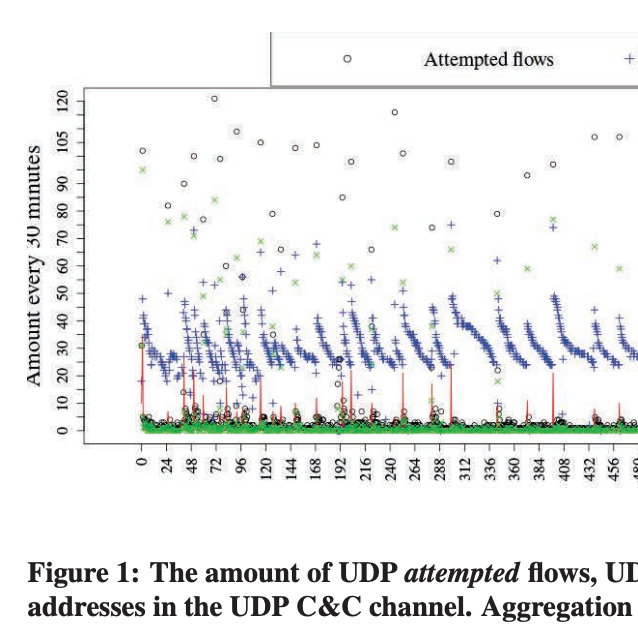
Through the analysis of a long-term botnet capture, we identified and modeled the behaviors of its C&C channels. They were found and characterized by periodicity analyses and statistical representations. The relationships found between the behaviors of the UDP, TCP and HTTP C&C channels allowed us to unify them in a general model of the botnet behavior. Our behavioral analysis of the C&C channels gives a new perspective on the modeling of malware behavior, helping to better understand botnets.

Ensembling to improve infected hosts detection

In this paper we describe the main ensemble learning techniques and their application in the cybersecurity threats detection. The state of the art in the use of ensemble learning techniques is presented here as an alternative to the current intrusion detection mechanisms, analyzing their advantages and disadvantages. We propose to incorporate ensemble learning to SLIPS [3], a behavioral-based intrusion detection and prevention system that uses machine learning algorithms to detect malicious behaviors, to obtain better results, taking advantage of the benefits of the SLIPS classifiers and modules. As part of this work we extend ensembling by considering algorithms from different domains (not machine learning domains), as Thread Intelligence. As a first stage of this project, performance tests of ensemble learning algorithms were performed to detect malware from flows evaluating its accuracy. The results of these tests are presented here, as well as the conclusions obtained and the future work.

Detecting DNS Threats: A Deep Learning Model to Rule Them All

Domain Name Service is a central part of Internet regular operation. Such importance has made it a common target of different malicious behaviors such as the application of Domain Generation Algorithms (DGA) for command and control a group of infected computers or Tunneling techniques for bypassing system administrator restrictions. A common detection approach is based on training different models detecting DGA and Tunneling capable of performing a lexicographic discrimination of the domain names. However, since both DGA and Tunneling showed domain names with observable lexicographical differences with normal domains, it is reasonable to apply the same detection approach to both threats. In the present work, we propose a multi-class convolutional network (MC-CNN) capable of detecting both DNS threats. The resulting MC-CNN is able to detect correctly 99% of normal domains, 97% of DGA and 92% of Tunneling, with a False Positive Rate of 2.8%, 0.7% and 0.0015% respectively and the advantage of having 44% fewer trainable parameters than similar models applied to DNS threats detection.