
The original Slips pipeline is good at turning traffic into evidence. It can detect scans, suspicious ports, DNS anomalies, HTTP oddities, TLS issues, and many other behaviors, and it can do that across large volumes of traffic. But producing evidence is not the same thing as having an immune response.
If every suspicious event is treated in isolation, the system misses some of the most important immune ideas:
- recognition should be separated from activation
- danger should matter, not just pattern match
- tolerance should be explicit
- memory should be explicit
- containment should happen only after enough evidence and context accumulate
That is the problem the T Cell module is trying to solve.
Slips is now moving from a pure detection pipeline toward a system that implements immunology concepts directly. The existing detector structure remains the innate layer, and the adaptive layer is added on top.
Slips now has an immune-style responder that sits on top of the existing evidence pipeline and decides when recognition should stay tolerant, when it should activate, when it should contain, and when it should store memory.
That responder is:
modules/t_cell/t_cell.py
It is not a replacement for the old detectors. It is an adaptive layer that
uses the old detectors as its innate immune system and uses the accepted regex
repertoire from RegexGenerator as its recognition library.
That connection matters because the adaptive side in Slips is now split into two cooperating pieces:
RegexGeneratorcontinually generates new candidate receptors through the sharedLLMmodule and keeps only the regexes that survive local selectionT Cellconsumes those accepted receptors against livePAMPevidence and combines them withDAMPdanger context to decide what to do
Innate and Adaptive Immunity in Slips
The immune split in Slips is now clear:
- the innate immune system is the existing Slips detection structure plus the
central
PAMP/DAMPsignal tagging - the adaptive immune system is the combination of
RegexGeneratorandT Cell
This is the important architectural idea.
The old Slips modules still do what they always did:
- inspect network behavior
- detect suspicious conditions
- emit evidence
What changed is that Slips now centrally tags evidence with an
evidence_signal:
PAMPDAMP
That gives the T Cell module a biologically meaningful input vocabulary.
The adaptive part then adds two capabilities:
RegexGeneratorcreates a validated receptor library.T Celluses that library plus live danger context to decide what to do.
What the T Cell Module Actually Does
The T Cell module subscribes to the shared evidence_added channel.
For each relevant evidence, it stores its own observation and then decides whether a T cell should:
- stay mature
- recognize an antigen
- become tolerant
- activate
- contain
- remember
It tracks one cell per:
- responsible IP
- regex type
- normalized antigen value
That means the unit of response is not "all evidence for a profile." It is a more precise adaptive unit tied to a responsible source and one structured antigen candidate.
Why the Responsible IP Matters
One of the key implementation details is that T Cell does not simply act on
evidence.profile.ip.
Slips evidence has several roles at once:
profile.ip: the related profile bucketattacker: the responsible entityvictim: the target entitydirection: whether a network entity appeared on theSRCorDSTside
Those are not the same thing.
T Cell derives a responsible IP from the evidence and uses that value for:
- cell ownership
- danger aggregation
- reevaluation
- containment
So when the evidence says one machine was the victim but another was the attacker, containment targets the responsible source, not just the profile bucket that happened to hold the evidence.
The Connection to RegexGenerator
The T Cell module depends directly on the regex repertoire built by
RegexGenerator.
When a PAMP arrives, T Cell extracts structured antigens such as:
- domains
- URIs
- filenames
- TLS SNI values
- certificate common names
It then checks whether any accepted regex of the same type matches that antigen.
This is the adaptive recognition step.
Without RegexGenerator, T Cell would still see PAMP and DAMP, but it
would not have a receptor library to consult. With RegexGenerator, the T Cell
can treat live evidence as candidate antigens and test them against an accepted
adaptive repertoire.
That is why the two modules belong together conceptually:
RegexGeneratorbuilds the receptorsT Celluses them in live response
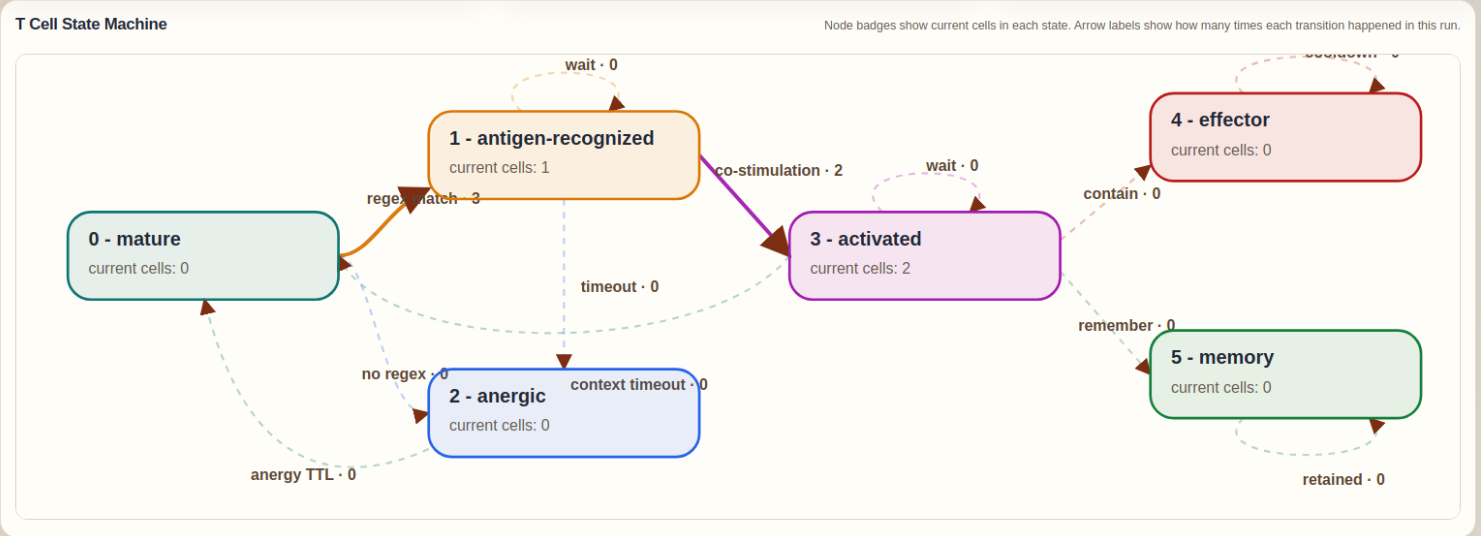
State 0: Mature
Every cell starts in:
0 - mature
At this point there is no recognition yet.
The module stores the observation and checks whether the evidence can even produce a usable antigen candidate. If not, the evidence is logged and kept as observation data, but it does not create a useful recognition event.
From Mature to Antigen Recognition
Only PAMP evidence can start recognition from 0 - mature.
That is deliberate. PAMP is the structured trigger that tells the adaptive
layer there may be something pathogen-like worth recognizing.
T Cell extracts antigen candidates from:
- evidence entities
- linked DNS altflows
- linked HTTP altflows
- linked SSL/TLS altflows
If an accepted regex matches one of those antigens, the cell moves to:
1 - antigen-recognized
If an antigen is present but no accepted regex matches, the cell moves to:
2 - anergic
That is the tolerance path. The system saw a candidate antigen, checked its adaptive repertoire, and found no reason to escalate.
Co-Stimulation: Recognition Is Not Enough
A recognized antigen still does not automatically become an active response.
The next question is whether there is enough danger to justify activation.
The module computes co-stimulation from:
- the confidence of the current
PAMP - the number of related
PAMPobservations - the weighted cumulative danger seen for the same responsible IP
That danger term includes both:
PAMPDAMP
This is exactly where the innate and adaptive layers meet.
The regex match says:
- this pattern looks recognizable
The co-stimulation score says:
- is the surrounding danger level high enough to matter?
If the threshold is crossed, the cell becomes:
3 - activated
If not, the cell can wait for one Slips time window in an explicit waiting substatus.
Why DAMP Matters So Much
DAMP evidence does not create a new T cell by itself.
But it is still crucial.
DAMP does three important things:
- it is stored as danger context
- it contributes to the cumulative danger term in co-stimulation
- it re-triggers reevaluation of cells that are already waiting
That means the innate danger layer is not passive background data. It actively shapes how the adaptive layer behaves.
Without DAMP, T Cell would only know that something matched.
With DAMP, T Cell can tell whether the surrounding situation is intensifying,
stable, or cooling down.
Context: Activated Is Still Not the End
Once a cell reaches:
3 - activated
it still needs to decide what kind of response makes sense.
The context stage looks at:
- novelty
- related evidence volume
- recent pressure versus previous pressure
- weighted
PAMP+DAMPdanger
The purpose of this stage is to distinguish between two very different situations:
- a new, intense threat that should be stopped quickly
- a familiar threat pattern that is still visible but already cooling down
Effector vs Memory
If the context signals say the threat is new and intense enough, the cell moves to:
4 - effector
At that point T Cell reuses the existing Slips containment path and can trigger blocking behavior such as ARP-poisoning-based isolation through the normal blocking flow.
If the context signals say the threat is familiar and decreasing, the cell moves to:
5 - memory
That path stores:
- the matched regex
- the matched value
- the context snapshot
in the T Cell SQLite store for later reuse.
This is what makes the module more than a simple thresholded blocker. It is explicitly modeling both response and retention.
Waiting Is a First-Class Runtime Condition
Two states can wait:
1 - antigen-recognized3 - activated
Those are not extra numbered states. They are explicit waiting substates recorded on the cell context:
- waiting for co-stimulation
- waiting for context
That makes the runtime easier to interpret because a cell can be:
- recognized but still not dangerous enough
- activated but still not ready for effector or memory
And both of those waiting conditions are reevaluated on later PAMP or later
DAMP arrivals for the same responsible IP.
Why This Is More Than a Fancy Alert Filter
The T Cell module is not just filtering alerts after the fact.
It adds an actual stateful decision layer:
- recognition
- tolerance
- co-stimulation
- activation
- context
- effector response
- memory
That matters because it lets Slips reason about events across time instead of treating each evidence row as a fully independent trigger.
The module is effectively asking:
- does this look recognizable?
- is it dangerous enough?
- is it urgent enough?
- or is it something we should remember instead?
That is a very different model from direct one-shot escalation.
Why the T Cell Module Needs the Regex Module
The T Cell module can only be adaptive because it has something adaptive to consult.
That comes from RegexGenerator.
If the regex module did not exist, T Cell would still have:
PAMPDAMP- danger aggregation
- thresholds
But it would not have a selected symbolic recognition library.
It would know danger, but not adaptive antigen recognition.
So the full adaptive design requires both modules:
RegexGeneratorcreates the detector repertoire through pseudo-generation and negative selectionT Celluses that repertoire inside a state machine that decides whether to tolerate, activate, contain, or remember
Why This Is an Immune System and Not Just a Metaphor
The mapping is close enough to be useful in engineering terms:
- old Slips detectors -> innate sensing
- central
PAMP/DAMPtagging -> innate danger language RegexGenerator-> adaptive receptor repertoire generation- benign-corpus rejection -> negative selection
T Cellstate machine -> activation, tolerance, context, effector, memory
The value of the metaphor is not decoration. It gives Slips a concrete design for how to:
- add adaptive recognition without replacing the old system
- separate recognition from activation
- separate activation from action
- keep explicit tolerance and explicit memory
What You Can Inspect
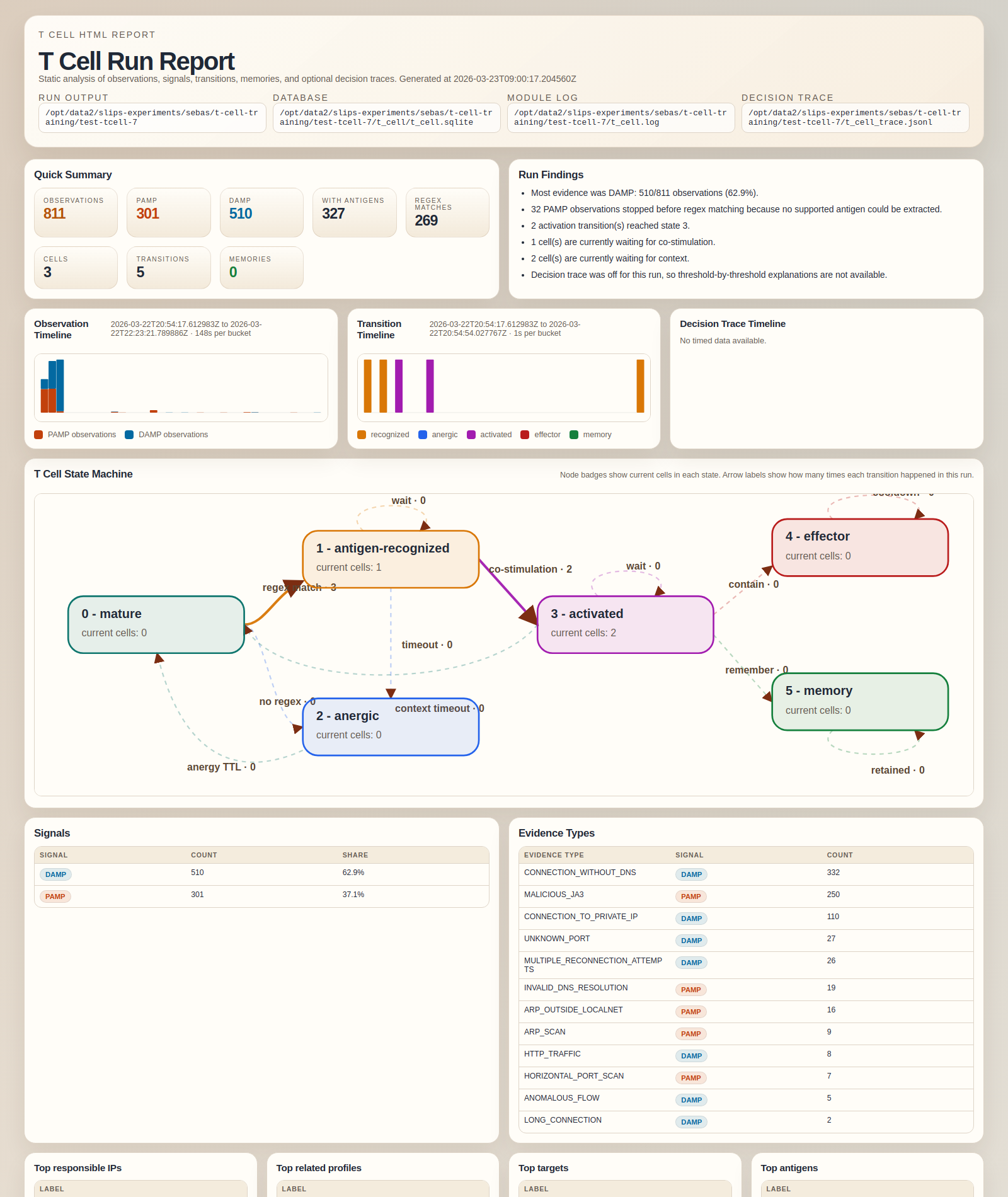
The module stores its own artifacts per run:
t_cell.logt_cell.sqlite- optional
t_cell_trace.jsonl t_cell_report.html
The report gives a static explanation of what happened:
- how much of the run was
PAMPversusDAMP - which antigens were extracted
- which regexes matched
- which cells moved through the state machine
- which cells are waiting now
- which cells became memory or effector
- why thresholds were crossed when decision tracing was enabled
So the module is not only stateful. It is also inspectable.