


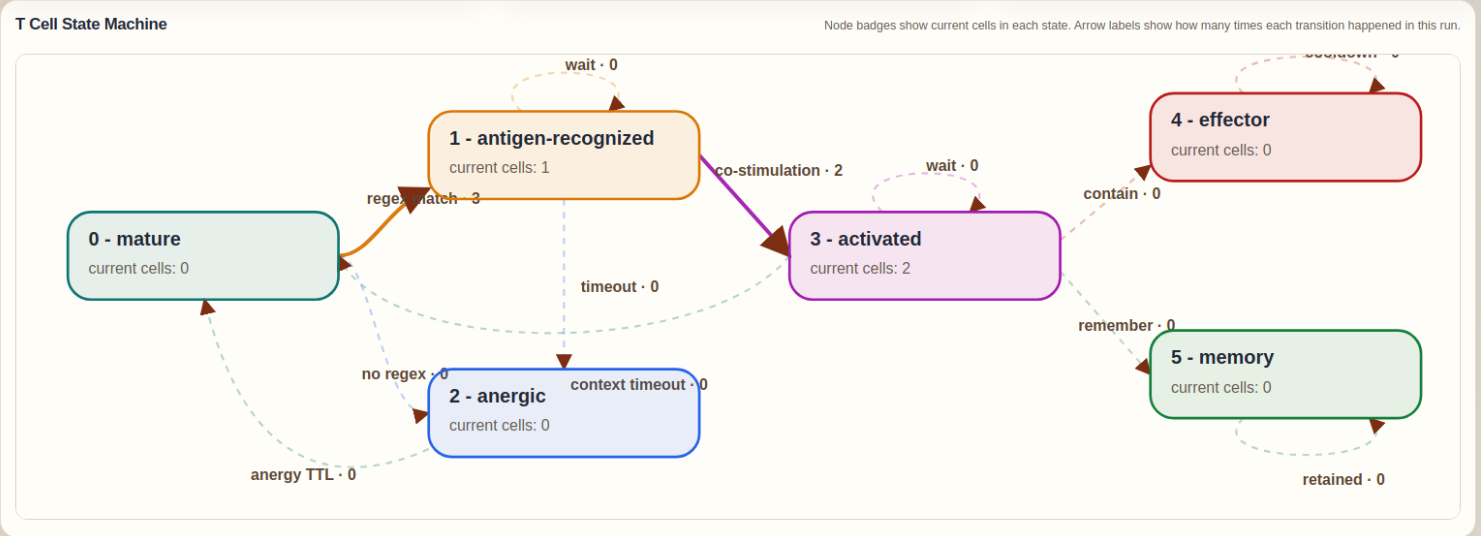
The T Cell module was created to give Slips a stateful adaptive response layer on top of its existing evidence pipeline. While the original detectors already provide the innate immune component through PAMP and DAMP evidence, the T Cell module adds antigen recognition, co-stimulation, context evaluation, tolerance, activation, effector action, and memory. It does this by extracting structured antigens from live evidence, matching them against the accepted regex repertoire generated by RegexGenerator, and then combining that recognition with the cumulative danger signaled by recent PAMP and DAMP observations. This allows Slips to move from isolated detections to a more explicit immune decision process that can decide when to ignore, when to contain, and when to remember.

